
Golf in the AI Age · Part 3 of 3
The AI Was the Easy Part. The Value Was Everything Under It. — Part 3
In Part 1 an AI rebuilt my bag. In Part 2 it told me to stop tinkering. Everyone who read those asked the same question: "So… you just used ChatGPT?" That question is exactly why most AI projects — in golf and in business — quietly fail. Here's what was actually under the hood, and why it's the real product.

The Engine Room.
Every time I tell this story, I get the same reply: "Cool — so you just asked ChatGPT?" And I get why. You type a question, an answer comes back, magic. But that assumption is also the single biggest reason most companies waste a year and a budget on AI and end up with a chatbot nobody uses.
Because "just asking ChatGPT" is the part that took me about four minutes to figure out. The part that actually mattered — the part that made the model fit my bag better than a fitter who'd watched me for a decade — took months, and it had almost nothing to do with the AI. Let me be blunt about it, because this is the whole point of Part 3:
"The model is the commodity. The context is the moat. Everyone has the same AI. Almost no one builds the thing that makes it yours."
The Fitting
How I educated an AI model to understand my body, my swing and my numbers well enough to rebuild my entire bag.
The Bag
The results. My new setup put to the test — the validation, the numbers, the misses and the tweaks.
The Engine Room
The tech, the model and the data underneath it all — and how it ties back to Stackory and the way we work.
You're hereCatching up? Start with Part 1 — The Fitting and Part 2 — The Bag. This one is the part underneath both of them.
The uncomfortable truth: the AI is the easy part.
Here's what most people don't want to hear. The large language model — Claude, GPT, whichever — is a utility now. It's electricity. You, me, my competitors, a 14-year-old in his bedroom: we all plug into the same wall. If the model were the advantage, there would be no advantage, because everyone has the identical one.
So if I'd done what most people do — open a chat window and type "I'm a 2.9 handicap, what driver shaft should I play?" — I'd have gotten a perfectly reasonable, perfectly generic answer. A magazine answer. The same answer it would give you, or anyone. Confident, plausible, and not actually about me at all.
That gap — between a generic answer and one that's genuinely, specifically yours — is the entire product. It's the difference between a horoscope and a medical chart. And closing that gap is not a prompting trick. It's an engineering and data problem.
What I actually built: a stack, not a prompt.
I didn't have a conversation with an AI. I built it a structured model of me — and then let the AI reason on top of it. Think of it in layers, bottom to top. (Yes, a stack. The name was right there.)
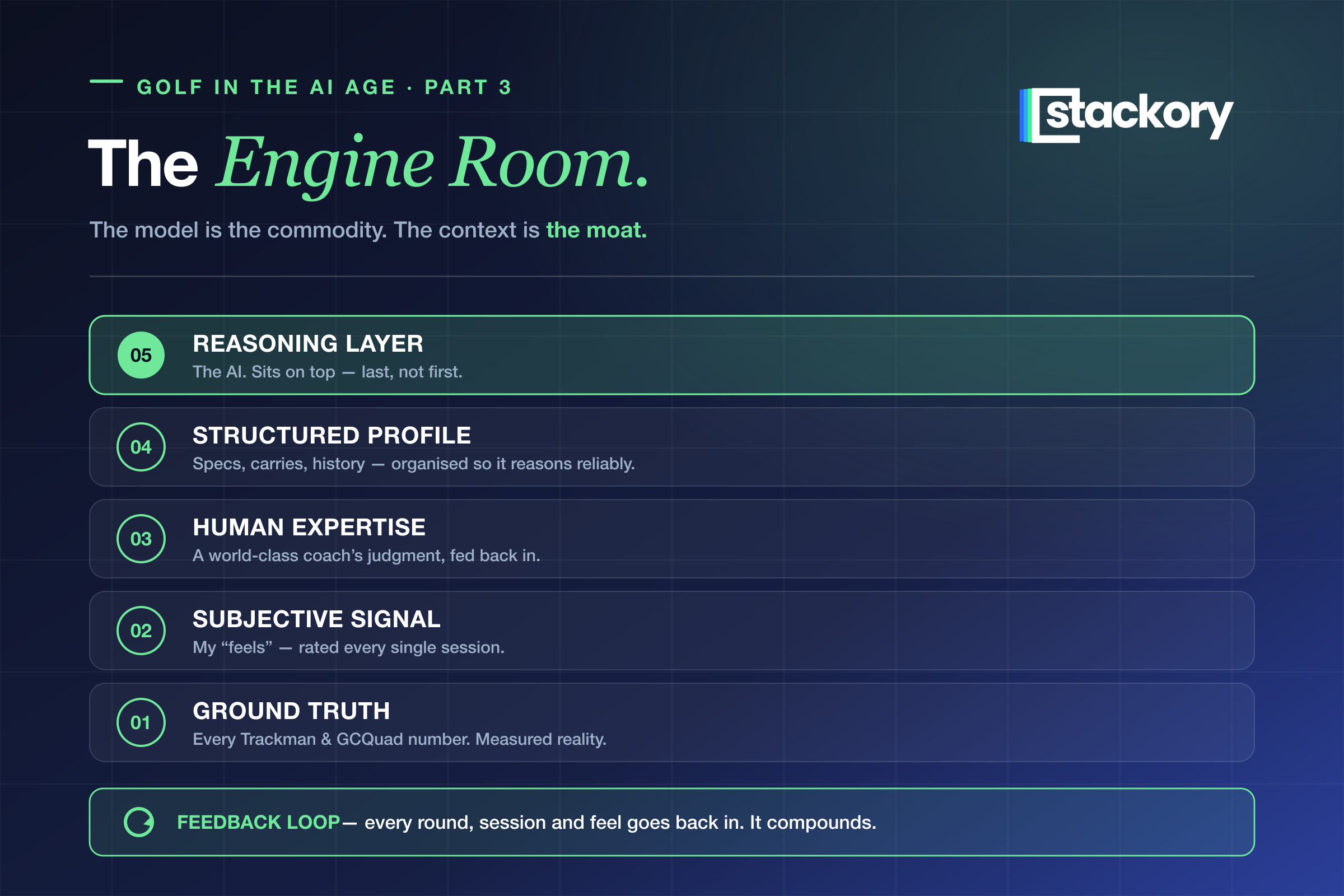
Layer 1 — Ground truth. The objective, un-arguable data: every GCQuad and Trackman number, captured the same way every time. Carry, spin, club path, face-to-path, dispersion. This is the floor the whole thing stands on. No feelings, no opinions — measured reality.
Layer 2 — Subjective signal. The layer almost everyone skips, and the one that made all the difference: my feels. After every session I logged a rating based purely on how it felt and looked — not the numbers. Why feed an AI something so unscientific? Because golf, like most things humans actually do, is played on feel, and a recommendation that ignores how something feels is one you'll abandon by the third hole. The magic isn't the data or the feel. It's teaching the system to hold both and reconcile them.
Layer 3 — Human expertise. This is where Cheryl Anderson came in. A world-class coach who's watched me swing gave the system things no sensor can — my biomechanical limits, my tendencies under pressure, what's actually fixable. I fed her judgment back in as structured input. The AI didn't replace the expert. It scaled her.
Layer 4 — The structured profile. All of that, organised. Not a pile of chat logs — a consistent, versioned schema: my body, my specs (length, lie and loft on every club), my carry targets (actual vs. want vs. preferred), my grips, my session history. Entities and relationships the model can reason over reliably, the same way every time.
Layer 5 — The reasoning layer. Now, finally, the AI. It sits on top — last, not first. Its job isn't to know things; it's to reason across everything underneath it and surface what I'd never spot myself.
The feedback loop. And it never stops. Every round, every session, every "that didn't feel right" goes back in. The system gets more me every week. That's the part that compounds — and compounding is what builds a moat.
Why it knows me better than I know myself.
That line in Part 2 wasn't a flourish. It's literally true, and the stack is why.
I forget. I remember my last good round and my last bad shot, and I weight them way too heavily — every golfer does. The system doesn't forget anything. It's holding hundreds of shots, dozens of sessions, my feel ratings and the cold numbers, side by side, with perfect recall. So when my feel said "the 3-wood is four yards short, get a new shaft," the system could look across every session and say: your club speed never moved — this is a strike-and-path pattern, not a shaft. It caught me lying to myself, gently, with the receipts.
A human fitter can't hold that much longitudinal context. I certainly can't. That's not the AI being smart. That's the system having a memory I don't.
The test that separates a system from a chatbot.
Here's the cleanest way I know to tell a real system from a chatbot wearing a lab coat: give it the same ten shots, twice. Do you get the same answer both times?
With our engine, yes — every time. With a chatbot, no. And that single fact is the whole ballgame.
A large language model doesn't know your actual miss pattern. It knows what miss patterns generally look like — and where your data runs out, it fills in the rest with the average of everyone. That's not analysis; it's a confident guess dressed as one. Sometimes it's close. Sometimes it's a hallucination you can't even see, because it arrives in the same self-assured tone as the truth.
Our system doesn't guess, and it doesn't drift. It isn't one opinion, either — it's an ensemble scoring the value of every shot and the variance around it, weighted across your last 5, 10 and 20 rounds. So it's constantly asking the question a chatbot never will: is this history still representative of the player standing on the tee today? Your game six months ago isn't the one you've got now — and the system knows the difference between a pattern that's stable and one that's just stale.
Feed our system ten identical shots and it returns the identical recommendation — every time. Feed a chatbot the same thing and you'll get ten shades of plausible. Reproducibility is the line between a tool you can trust and a guess you can't.
So why can't everyone just do this?
They can try. And here's the honest answer to "couldn't anyone copy this?" — sort of, and that's exactly why it's defensible:
- The data is mine and it took months to build. You can't prompt your way to a season of structured, validated, feel-rated launch-monitor history. It only exists because I built it, shot by shot. A competitor starting today is a season behind, and the gap widens daily.
- Depth beats access. Anyone can access the same model. Almost no one will do the unglamorous work of structuring their reality so the model can reason on it. Output quality is a direct function of that depth — and most people stop at the chat window.
- It compounds. Every week it knows me better. A copy isn't a copy of a finished thing; it's a copy of day one. The moat isn't the snapshot. It's the slope.
Generic in, generic out. Personal in, uncopyable out. That's the USP, and it's not a slogan — it's the architecture.
Now the part that was never about golf.
If you've read this far thinking it's a very elaborate way to talk about a 3-wood — it isn't. Everything I just described is exactly what we build at Stackory, except the "golfer" is a golf club, an association, or an operator, and the "bag" is their business.
Most companies are about to make the same mistake I didn't. They'll buy "an AI." They'll bolt a chatbot onto a broken process and wonder why it gives generic answers — because they skipped every layer under the model. They started at Layer 5. Here's how we actually think about it.
How (and when) Stackory adopts AI.
- AI is the last layer, not the first. If your data is a mess in six disconnected systems, AI doesn't fix that — it launders it into confident nonsense. We build the substrate first. The model goes on top, last.
- The moat is your data, structured — not the model. Your members, your history, your operations, organised into something a model can reason over. That's the asset nobody can copy, because it's yours. The model is rented. The context is owned.
- Personalisation is the whole game. A generic AI answer is worth roughly nothing, because your competitor can get the identical one. The value is entirely in how specifically it knows your business. We optimise for that gap, relentlessly.
- Keep a human in the loop where judgment lives. Cheryl didn't get replaced; she got scaled. Same in a business — AI handles the recall and the pattern-finding; humans keep the judgment, the taste and the accountability.
- Know when not to. My own AI told me to stop tinkering — to stop adding things that didn't need adding. The same discipline applies to AI adoption itself. Not every problem is an AI problem. Sometimes the right answer is a spreadsheet, a process fix, or a strip of lead tape. Knowing when AI isn't the answer is as valuable as knowing when it is — and it's the fastest way to tell a real partner from a vendor selling hype.
"Being 'in the AI era' isn't a strategy. Knowing exactly how — and when — to adopt it is. That judgment is the product. The model is just the tool it points."
The engine room.
So, no — I didn't "just use ChatGPT." I built a system that turned a generic model into something that understands me specifically, that gets better every week, that reconciles cold data with human feel, and that occasionally has the nerve to tell me I'm the problem. The clubs were never the point. The bag was just the first thing I pointed the engine at.
The handicap goal from Part 2 still stands — 2.9 today, scratch the plan, plus the dream. But the real takeaway of this whole series isn't a number on a scorecard. It's that the same engine room that rebuilt my bag is the one we build for businesses that want AI to actually mean something — not a chatbot, not a press release, but a compounding, personalised advantage nobody else can copy.
The clubs were never the point. The real discovery was this: build the engine right, and AI stops guessing and starts telling you the truth — about your swing, your business, yourself. That was never a golf story. It's a starting line.
Gareth Londt — Founder & CEO