
Golf in the AI Age · Part 2 of 3
My AI Fitter Told Me to Stop Tinkering. — Part 2
In Part 1 an AI model rebuilt my entire bag. In Part 2 I had to actually play it — through scrappy rounds, a brand-new driver that humbled me in five holes, championship golf that exposed every weak spot, and the moment my own model looked at the data and told me to put the screwdriver down.

My AI fitter told me to stop tinkering.
If Part 1 left you thinking "golf nut" was the takeaway — let me correct the record. Golf nut is a wild understatement. Here's the thing I need you to believe before any of Part 2 makes sense: data is everything, and an AI model is only as good as how well you teach it about you. Feed it generic inputs and you get generic answers — a magazine fitting with a chatbot accent. Feed it your actual body, your actual misses, your actual feels round after round, and it becomes something else entirely. A fitter that remembers everything and flatters nothing.
And I'll be honest about what that obsession costs, because it's part of the story: more shafts than my wallet wants me to list, more launch-monitor hours than a sane person allocates, and a workshop drawer that looks like a small pro shop went out of business in it. This is the expensive hobby underneath the smart system. Keep that in mind every time the AI sounds reasonable and I don't.
The Fitting
How I educated an AI model to understand my body, my swing and my numbers well enough to rebuild my entire bag.
The Bag
The results. My new setup put to the test — the validation, the numbers, the misses and the tweaks.
You're hereThe Engine Room
The tech, the model and the data underneath it all — and how it ties back to Stackory and the way we work.
New here? Start with Part 1 — that's where the AI builds the bag. This one is where the bag has to earn it.
The four things I couldn't let go.
So I had this beautiful new traditional bag from Part 1. On paper, dialed. In the back of my head? A few things were still itching:
- The driver was leaking left. A left miss I did not love.
- The 3-wood launched too low. Useful, but never a weapon.
- The gap wedge felt light — noticeably out of step with the rest of the wedges.
- And the putter. I was gaming Bryson's exact armlock setup — the one with the LA Golf shaft that is essentially impossible to find. We didn't have one. We had two. (Don't ask.)
A normal person leaves those alone and goes to play golf. I am, as established, not that person. So back down the rabbit hole we went.
The driver rabbit hole.
I did what I always do now: ask the model what the perfect shaft would be if I were a robot — then deliberately back off it, because the odds of me swinging like a robot are, generously, zero. I put real data on the board across five shafts:
- Diamana BB 63X
- LA Golf Gold Series
- Ventus VeloCore Blue
- Tour AD DI
- Speeder NX Violet
I'll spare you the shaft-by-shaft. Two separated themselves clearly: the Diamana BB and the Ventus Blue. The head was never in question — Titleist GT2, not close, not worth another minute. From there it was details, and details are where fittings are actually won:
- Adapter: I needed a touch more lie and fewer cut-shaped shots, so we landed on A2.
- Grip: after testing materials and sizes, the Golf Pride MaxAlign Plus 4. It helped me release the head, and it's heavier than a standard grip — which, coming off those very heavy jumbo grips from my single-length days, made the transition feel natural rather than alien.
"I asked the model what a robot would play. Then I built the version a human could actually swing. That gap — robot-optimal vs. human-repeatable — is the whole game."
The gap-wedge problem nobody warns you about.
Then the gap wedge. Turns out gap-wedge heads are so light that the club simply wouldn't match the swing weights of the rest of my setup. The fix for testing was unglamorous and perfect: lead tape. Sometimes the AI-optimized answer is a strip of tape and a launch monitor.
The putter saga — oh boy.
Buckle up. Bryson's armlock actually taught me things — especially about start lines. My short putts got better. The long ones? Not so much. Then I did what every honest golfer eventually admits to: I got caught by the marketing. L.A.B. ads all over Instagram and Facebook, and I ate the cheese. Started with a DF3. Didn't love the look — but I'd reached the point where performance beats pretty.
From there it was a tour of the lineup:
- DF3 → too soft for my stroke (great for many; not for me)
- Armlock OZ.1
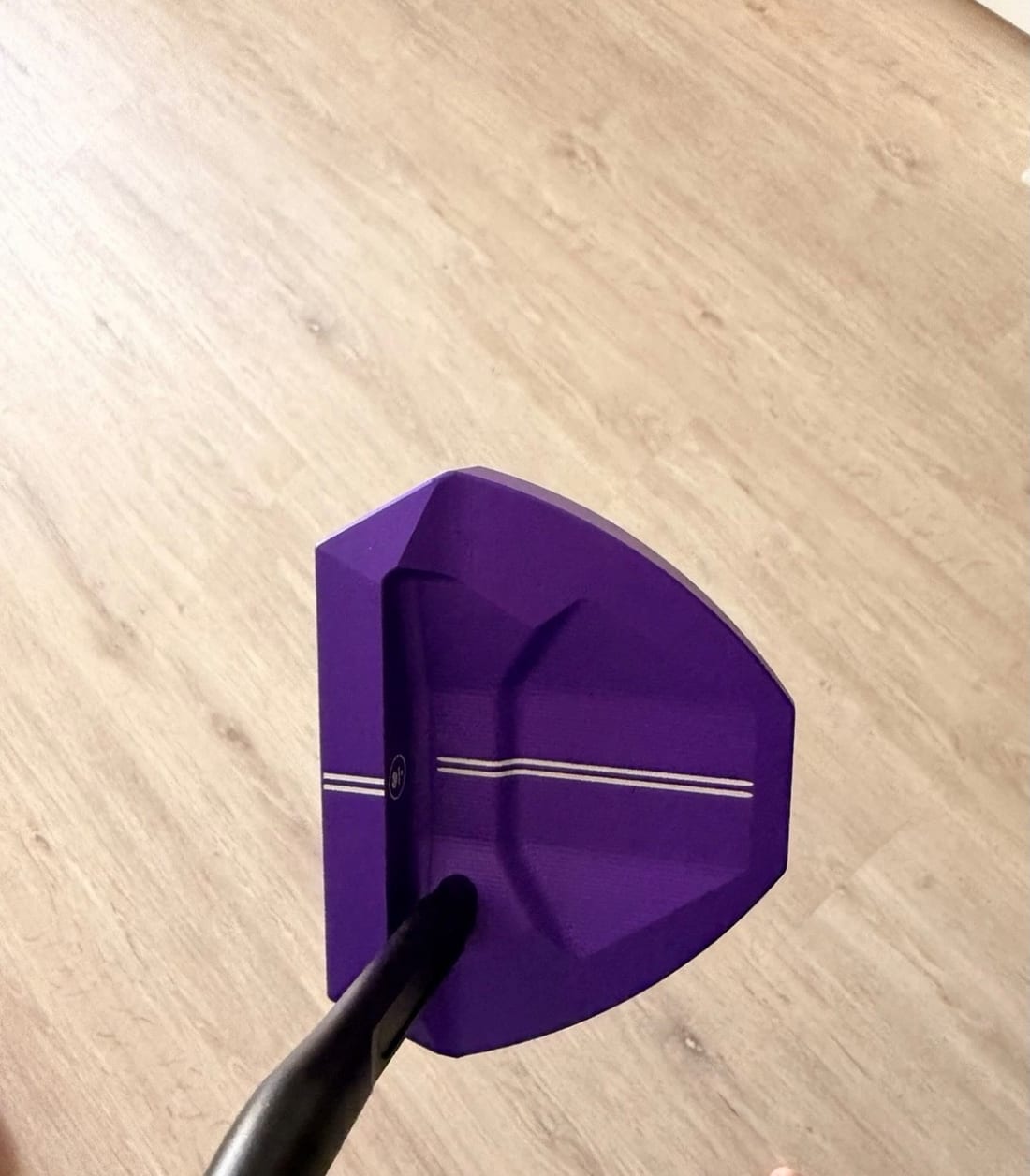
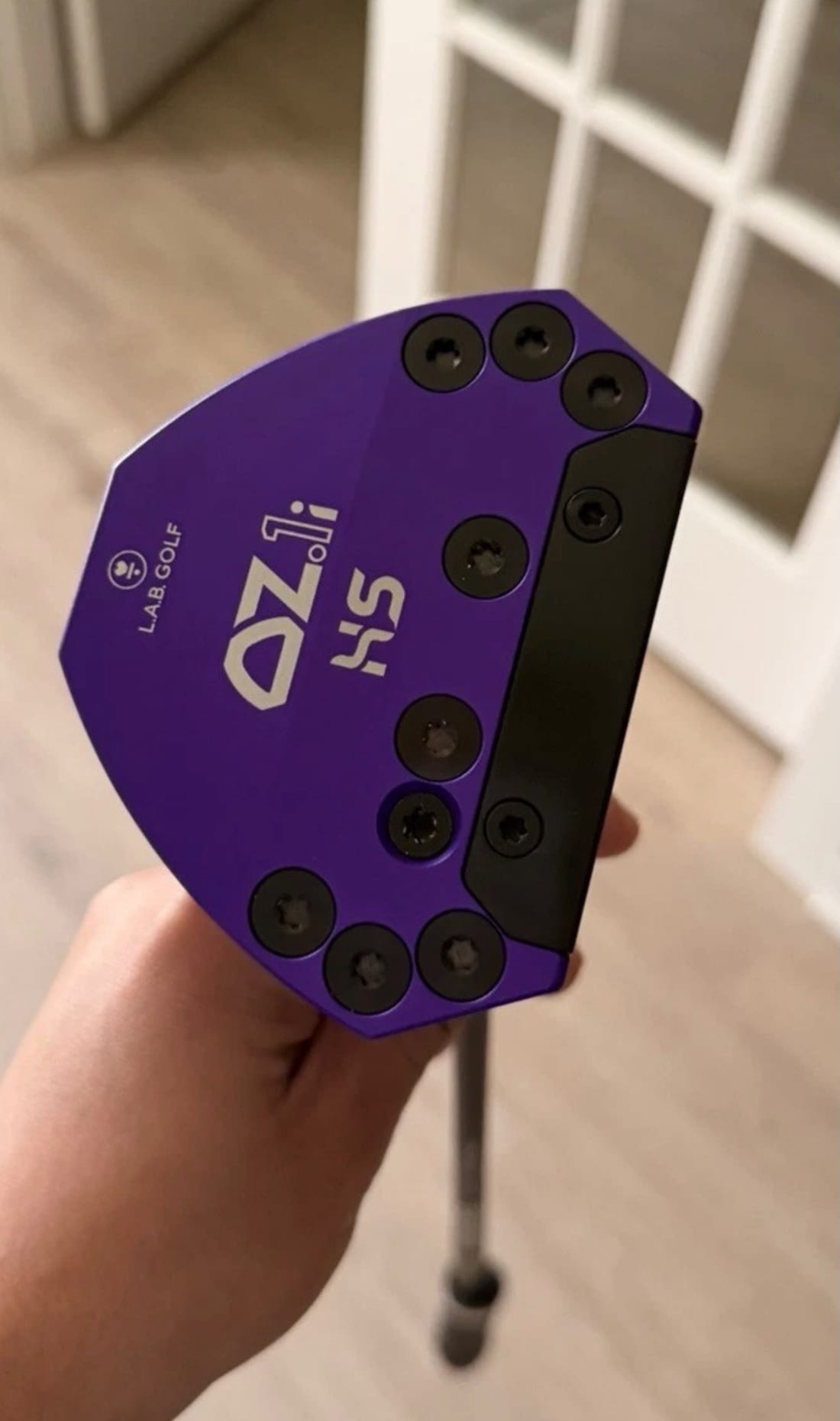
- OZ.1i HS
And we landed on the OZ.1i HS at 35". Center-shafted models I just couldn't line up — that's a me problem, I own it — and the DF3's softness wasn't my friend. Then came the piece that tied the whole thing together: the TPT putter shaft. I genuinely struggle to put the feeling into words. It's so stable, so right for my stroke, that I couldn't put it down. Final spec: 0° shaft lean, 0° forward press, 70° lie.
Built. Now actually play it.
Bag locked. Nothing screaming at me anymore (well — the 3-wood was still whispering). I was ready to grind. But here's the reality check for every gearhead reading this: changing your entire bag — let alone flipping your whole philosophy from single-length to traditional — and expecting it to click overnight? That's asking way too much, way too fast.
First contact: the data vs. the feels.
The numbers came in clean off GCQuad and Trackman. Gapping was good. Distances felt right. The Srixon ZXi7 irons were genuinely great, and the KBS TGI shafts were very, very good. The driver — the Diamana BB 63X — was working beautifully (file that one away, there's more coming). The wedges, with their proper short lengths, were a thousand times better for control. The putter… was going to take some getting used to.
And then I took it to the course, and the first few rounds were… scrappy. Nothing fully locked in. My mind running carry numbers, second-guessing yardages, trust issues on every stock shot. Full Rain Man.

After about five rounds, the picture sharpened into five clear lessons:
- The 3-wood launched too low. (Still whispering.)
- The 5-wood was an absolute missile.
- The 5-iron was good — but only when I struck it perfectly, every time.
- The wedges were solid, but the MMT 105 shafts in them weren't giving me the control and confidence I wanted.
- Time to go back to my "fitter."
Back to the fitter — and a reply I did not expect.
I fed it the real numbers and, just as importantly, the feels. I laid out the issues with the main clubs and started fishing for tweaks everywhere else — opinions on length, loft, weight, the works. Its first response stopped me cold:
"Gareth — stop focusing on changing areas of the bag that don't need adjusting. Stick with the plan and get comfortable. These are the right setup."
I laughed out loud. Because I have heard that exact sentence from friends after they've beaten me — stop tinkering, the clubs are fine, go practice. It's one thing to hear it from your foursome. It's another to get told off by the machine you built. Hard to argue when it's holding all your data.
And honestly? This is the exact thing I tell clients every week: the answer is usually in the data you already have, not the shiny new thing you're about to buy. Apparently it's easier to give that advice than to take it from your own algorithm.
Fixing what actually needed fixing.
So we did something novel for me: we focused only on the things that genuinely needed fixing. With intention. (And then, naturally, Titleist released the GTS series — because of course they did, right on cue. More on that landmine shortly.)
- The 3-wood. The 13.5° just wasn't it. We moved to a 15° GTS3 with a UST LIN-Q Powercore Blue, tipped 0.75". Game changer. Huge jump in speed, a better flight window, more launch, great spin — suddenly a 3-wood that's a weapon both off a tee and coming into par 5s.
- The 5-iron. Kept the shaft, lie and loft — just swapped the head to the ZXi5 for more forgiveness, so I didn't have to flush it every single time.
- The wedges. Moved the 54 and 58 to Vokey Axiom 105s, and put the KBS TGI 95 in the gap wedge. Since I hit more full shots with the gap, my fitter's call was to keep the iron shaft running through the gap rather than break the set feel.
That 3-wood change wasn't a vibe — it showed up in the data. I pooled the best strikes across two sessions and the cluster told the story: a club I used to steer became one I could attack with.
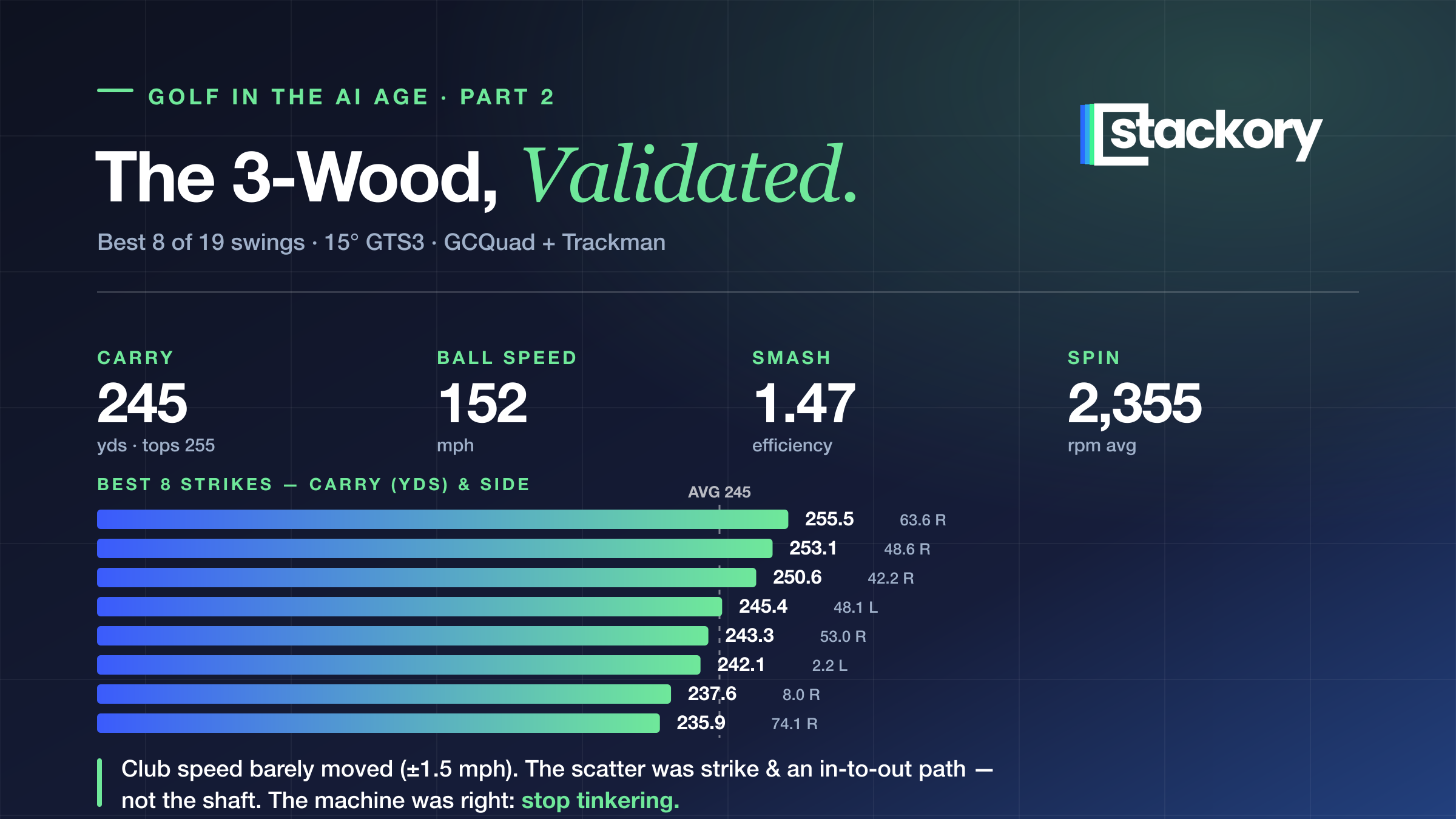
On my best swings the 3-wood now carries ~244 and tops 255 — a genuine par-5 weapon. The launch monitor also showed exactly why it sometimes isn't: my club speed never wavered (±1.5 mph), but my strike and an in-to-out path scattered the result 60+ feet right. The fix was never another shaft.
And then — full confession — I got my hands on a GTS3 9.0° driver head and started tinkering with the one club that wasn't even a problem. I know. I know. The model told me to stop. But it was new, it was the latest, and surely newer had to be at least a little better… right?
The Friday that sent me crawling back to the GT2.
(Quick aside: Stackory doesn't work Fridays — a perk I will defend to the grave.) So one Friday morning I teed it up with the GTS3. All stock. No weight tinkering. Pure out-of-the-box.
First tee, I flush one. Looks great. I'm already composing the smug text to my buddies. Then the 3rd bends left. The 5th leaks further left and I'm standing in the rough doing mental math I'd spent two months eliminating from my game. By the time I'm walking off that 5th green, there's a single thought on a loop: I want the GT2 back. Five holes. That's all it took for a "better" driver to undo a setup I trusted.
Before anyone yells "but the GTS3 is incredible!" — it is. But. Big but. I'd fed my fitter zero GTS3 data. I hadn't paired it with the right shaft. I hadn't checked whether its attributes even suited my swing. I just assumed new = better. That's not a fitting. That's shopping. So I hunted down a weight kit, found one, and three days later we were making real adjustments, sharing Trackman data, and finally comparing apples to apples.
"The GTS3 didn't fail me. I failed it — by skipping the exact process that made everything else in the bag work."
The tweaks that stuck
Part 2 · validated changesOut: GT2 13.5° / LIN-Q. In: more speed, higher launch, tighter gap to total.
- Head
- Titleist GTS3 · 15°
- Shaft
- UST LIN-Q Powercore Blue · tipped 0.75"
Same shaft, lie and loft — just a more forgiving head.
- Head
- Srixon ZXi5
- Shaft
- KBS TGI 95 (unchanged)
Off the MMT 105s that lacked confidence; gap kept on the iron shaft for full-swing feel.
- 54° & 58°
- Vokey Axiom 105
- 50° gap
- KBS TGI 95
0° shaft lean · 0° forward press · 70° lie.
- Head
- L.A.B. OZ.1i HS · 35"
- Shaft
- TPT
Championship season: the real exam.
Then NJ championship season arrived — mid-am and amateur qualifiers. Honest take on the mid-am: the course wasn't one I love, and it wasn't brutally long or demanding — a fair first test of a new setup under real pressure. Result? Let's just say… I needed more time with the bag. Not a disaster, not worth a single sentence of replay. And that's the lonely part of competitive golf nobody warns you about: standing on a championship tee with a bag you know is right on paper — every number validated, every spec earned — and still not quite trusting it when it counts. The gear was ready. I wasn't yet.
So with the mid-am behind me and the tinkering finally almost done (is it ever?), I pointed everything at the Amateur. I spent a few days on the range — real, focused practice, the kind that actually moves the needle (that's a whole other story, and an important one). I got comfortable hitting a handful of different shots through the new setup. And then it clicked. Ball-striking got so good it went on autopilot — the gear had gone quiet, which is exactly what you want it to do.
Quick detour, because I have to brag. Right around then, our club held its first-ever major — a four-man, two-best-ball format, and an absolute blast. I showed up rested, energized, and — for the first time all season — fully trusting the setup. Long story short: -19 as a team, +3 personally (no gimmies, everything putted out), and we walked off with the green jacket. Bragging rights, and the sacred right to set next year's menu. The bag wasn't whispering anymore.
Then, the NJ Amateur. Coming in off a few decent-but-not-tremendous rounds, the equipment wasn't plaguing me or whispering a thing — finally. A stable, consistent start: -1 through 9. And then I made the oldest mistake in the book — I looked at the leaderboard. I stopped playing the game that got me there (hit the green in regulation, worst case two-putt par) and started chasing a number instead. It worked for nine holes. It did not work for eighteen. I signed for +6, T36.
Here's the part that matters for this whole series: none of it was the equipment. Not one shot. It was mental — the confidence and discipline of being in contention (sort of) and then climbing out of my own way too late. The AI-built bag had quietly done its job. The thing left to fix wasn't in the workshop. It was between my ears.
Stop tinkering. Start scoring.
My AI fitter told me to stop tinkering. It took a green jacket and a T36 to prove it right — the bag was never the problem. I was the variable. And there's something oddly freeing in that. For two seasons I'd been quietly blaming equipment for outcomes that equipment was never going to fix. Now the excuse is gone: the clubs are dialed, the data agrees, and the only thing standing between me and a better number is me.
So let me put a stake in the ground — because that's the whole point of having the data. As I write this, I'm a 2.9. A year ago, with a bag fighting me, I'd have called that my ceiling. Now I think it's my floor. With the equipment finally neutral and the work pointed where it actually belongs — the swing, the short game, the discipline not to chase a leaderboard on the 10th tee — scratch isn't a hope for 2026, it's the plan. And if the mental game catches up to the ball-striking the way the ball-striking caught up to the model? Plus-handicap is on the table. Hold me to it.
Two seasons of blaming equipment — gone. The bag is neutral, the data's honest, and the ceiling just became the floor. Scratch is the plan, plus is the goal, and for the first time the only thing left to fix is the golfer. That's a problem I'd rather have.
And here's the part that was never really about golf. This is exactly how I approach every business I work with: get the data right, take the solvable problems off the table, and what's left is the work that genuinely needs a human. The AI didn't lower my handicap — it did something better. It removed every reason that wasn't me.
In Part 3 — The Engine Room — I'll open up the model itself: how it's built, what it's fed, the data that turned a generic chatbot into a fitter that knows me better than I know myself, and why the same process that fixed my 3-wood is the one we run at Stackory. The tinkering, it turns out, was never really about the clubs.
Gareth Londt — Founder & CEO