
Golf in the AI Age · Part 1 of 3
I Fired My Club Fitter and Hired an AI Model. — Part 1
A year ago I was playing a single-length set with jumbo grips — the same brand Bryson won a US Open with. This year I handed everything about my body, my swing and my numbers to an AI model and let it build my bag from scratch. A world-class coach kept it honest. This is how it went.

I fired my fitter and hired an AI model.
I'm a golf nut. I'll say that up front, because it's the only honest way to explain how I ended up here — sitting at a launch monitor at the start of 2026, feeding an AI model my carry distances, my lie angles, my StretchLab mobility numbers, and a strong opinion about the way a 7-iron should come off the face.
The title's a joke, by the way. Mostly. I didn't fire anyone — I just hired a second fitter that happens to live on my laptop, never sleeps, and has never once tried to upsell me a head cover. But to understand why I did that, you have to go back to where this actually started. Not in a fitting bay. In a decision I made in March of last year that broke almost everything I thought I knew about my own golf journey.
What this series is.
This is a three-part series — call it the field notes of a golf nut who handed his bag to an algorithm and lived to write about it.
The Fitting
How I educated an AI model to understand my body, my swing and my numbers well enough to rebuild my entire bag.
You're hereThe Bag
The results. My new setup put to the test — the validation, the numbers, the misses and the tweaks.
The Engine Room
The tech, the model and the data underneath it all — and how it ties back to Stackory and the way we work.
If you only read one, read the one that matches your itch: Part 1 is for the gear obsessives, Part 2 is for the score-chasers, and Part 3 is for the people who want to know how the sausage — sorry, the system — actually gets made.
The one-length experiment.
In March 2025 I went all-in on something most golfers would call reckless: a full set of Avoda One Length clubs. Every iron, every wedge — built to the same length. A 7-iron length, all the way through the bag. If you know the brand, you know the pedigree: these are the same clubs Bryson DeChambeau used to win the US Open at Pinehurst. That's not a small endorsement. Single-length isn't a gimmick when someone wins a major with the concept.
And they came with a particular feel. Large jumbo "tour series" grips — noticeably heavier than a standard grip, which changes the entire balance of the club in your hands. Heavier grip, single length, one swing for every iron in the bag.
Here's the thing nobody tells you: at first, it worked. Beautifully.
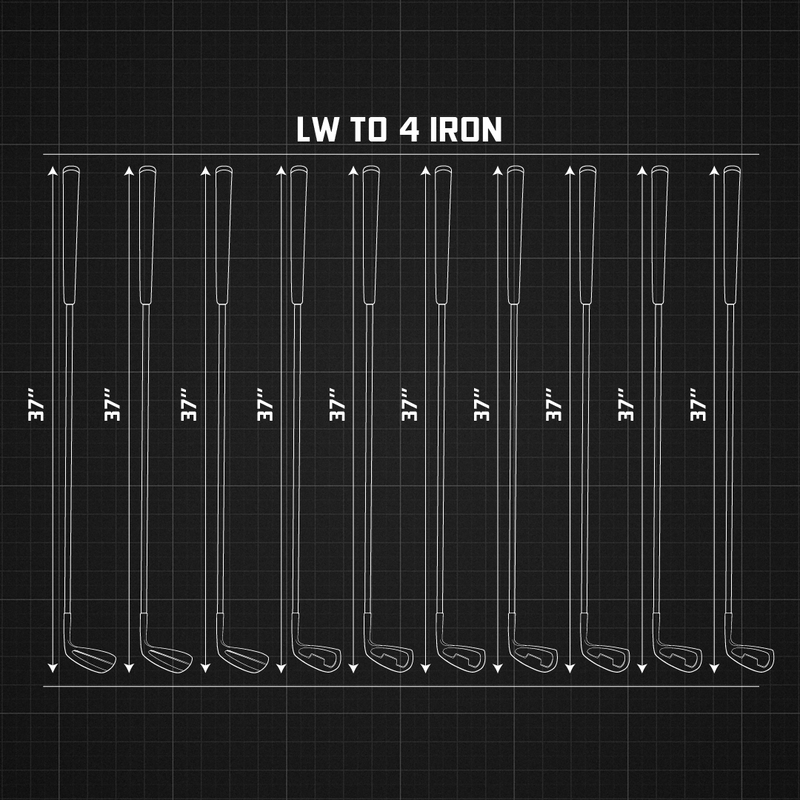
The whole promise of single-length is that you remove variables. Same length means the same posture, the same ball position, the same swing — every single time. For a guy running a consulting business who doesn't get to grind on the range for hours a day, that was a gift. It quieted the noise. It killed the swing thoughts. I'd stand over an 8-iron and a 5-iron and feel the same thing, and that consistency showed up in my ball-striking faster than I expected.
"Single-length didn't fix my swing. It removed the excuses my swing was hiding behind."
I leaned in harder. I moved my driver and woods to Krank heads, and put LA Golf shafts in literally everything — and I mean everything. I went through the whole range: 125 X-stiff, 120, 105, 85. If LA Golf made it, I tried it. My wallet has asked me not to talk about this period. I was chasing the right profile across every club in the bag, and I had the access and the obsession to actually do it.
A full season in, my swing was genuinely better. The mechanics had tightened up. The one-length concept had done exactly what it promised.
And then there were the wedges.
Where it fell apart.
I could not dial in the wedges. Full stop.
Single-length is wonderful for your mid and long irons — it lengthens your short clubs and gives them more consistency. But the short game lives and dies on feel: trajectory control, spin, the half-shots, the touch around the greens. And a wedge built to 7-iron length, with a jumbo grip and a long shaft, simply does not behave like a wedge your hands have trusted for twenty years.
I'm being honest here because the whole point of this series is honesty. To get those wedges where I needed them would have taken hours a week, for months. That's a real cost. And I run a consulting business — I don't have months of range time to spend re-learning how to hit a 50-yard shot.
So at the end of the season, I made the hard call. I went back to a traditional, variable-length setup. Not because single-length is wrong — it isn't — but because the trade-off didn't fit my life and my hands.
That decision is what brought me into 2026. And it's where this story really begins.
Why I handed it to a machine.
Going back to traditional gear meant re-fitting essentially my entire bag. Length, lie, loft, shaft, grip, swing weight — a dozen interlocking decisions, every one of which affects the others. The year before, I'd gone through Avoda's fitting system to dial in the single-length set. This time, I wanted a different kind of fitter. One that never forgot a number, never got tired, and could hold every variable about me in its head at once.
So I started teaching an AI model everything about me as a golfer.
I had two advantages most people don't. First, I'm that golf nut — I had access to equipment and the patience to trial-and-error my way through it. Second, I had data. Real data. I started fresh with a clean, traditional baseline:
- Titleist T150 (2025) irons, PW through 5-iron, with KBS $-Taper 120 steel shafts.
- Titleist Vokey SM10 wedges — 50, 54, 58 — with Hi-Rev 2.0 125 steel shafts.
And I started capturing everything off a GCQuad and Trackman.
Teaching it who I actually am.
This is the part that separates an AI model from a magazine fitting chart. I didn't ask it generic questions. I built it a profile — session after session — until it understood me the way a great fitter who's watched you for ten years would:
- My body. My age, my height, my athletic ability. The honest stuff: I'm not especially flexible in every area, but I've got room to gain clubhead speed. A fitter who doesn't know that will hand you a shaft your body can't load.
- My feels. What I want to feel through a set of irons. My expected flight window. The difference between my smooth swing and my aggressive one — and which one I bring under pressure (spoiler: not always the one I planned).
- My carry distances. Three numbers for every iron: the actual carry, the carry I want, and the carry I'd prefer — plus all the supporting data to judge whether a given club-and-shaft was actually working for me, or just flattering me on a good day.
- My specs. The length, lie and loft of every iron, written down and tracked.
- My grips. Midsize vs. standard vs. MaxAlign Plus 4 — and what each did to my hands and my release.
- A feel rating, every session. After each session I gave it a score based purely on feel and visuals — not dispersion, not numbers, not the launch monitor. Just: how did that feel? Because the data and the feel don't always agree, and a fitting that ignores feel is a fitting you'll abandon by the third hole.
A few weeks of that, and the model knew me. Not a golfer. Me.
Mechanics before equipment — and a human who actually knows my swing.
Then I started asking questions — but not about gear. About my swing first.
That order matters. You cannot fit equipment to a swing that isn't doing what it needs to do. Buy clubs around a flaw and you've just bought an expensive, beautifully-shafted flaw. So I asked the model about my mechanics before I let it touch a single spec.
At first, it was generic. It tried to fit me into the "magazine" swing — the one that looks perfect on paper, the textbook positions every instructor poster shows you. On paper it was great. In reality? My body doesn't get there. My biomechanics don't allow some of those positions, and no amount of wanting it makes them appear.
So I fed it more. I gave it the truth about how my body actually moves — including some baseline mobility data I'd gotten from StretchLab. (Shout-out to Jackie and the team at Livingston StretchLab — that data turned out to matter more than I expected.)
But the real unlock was human. In February, right after the PGA Show, I went and spent time with Cheryl Anderson — one of the top golf coaches in the country, and someone whose approach to my mechanics I genuinely love. Cheryl gets it. She understands my swing, my tendencies and my biomechanical limitations in a way no model can learn on its own — because she's watched me swing a club. Every insight she gave me, every limitation she confirmed, every priority she set — that became coach-led data I fed straight back into the model. The AI got smarter every time Cheryl spoke.
The only catch is geography. Flying to Florida every weekend to see Cheryl is, regrettably, not on the cards — and honestly, she'd probably take out a restraining order if I showed up that often. So the model became the thing in between: a way to carry Cheryl's coaching forward day to day, applied to my own data, without me living in an airport.
"The AI didn't replace a great coach. It made every hour I got with one go further."
And that's when it got really interesting.
Becoming the golfer and the fitter at once.
With the biomechanics in the model — and Cheryl's coaching layered on top — the questions I could ask changed completely. I wasn't a customer in a fitting bay anymore, nodding along to a fitter's opinion. I was the golfer and the fitter — holding a data pool of everything about me, cross-referencing it against the Avoda fitting I'd been through the year before, and interrogating every recommendation until it earned its place in the bag.
We started with the wedges. The clubs that had broken me the year before.
The wedges.
- Playing length brought to 35.75".
- Lie angle set to 1° upright — a meaningful change from the 3° upright I'd been playing.
- Lofts kept standard: 50 / 54 / 58.
- Grinds dialed in individually: 50/08F, 54/12D, 58/04T (Titleist SM10).
- And the big one — I switched to graphite shafts in the wedges.
I know. Graphite in wedges? Most people will ask why, and for what — and probably make a face while doing it. I was making the same face. Hold that thought — it runs through the whole bag, and I'll get to it.
The irons.
- Built 0.25" longer than standard. Not strictly required, but it helped me land the swing weights where I wanted them.
- New shafts throughout: KBS TGI 95 Stiff++ graphite.
- All irons 1° upright.
- Grips moved to Golf Pride MaxAlign Plus 4, midsize. Coming off those jumbo single-length grips, dropping to a midsize — even a Plus 4 over a tour velvet — felt like trading a baseball bat for a pencil. My hands filed a formal complaint. They got over it.
- And the heads changed too: off the Titleist T150 and into Srixon ZXi7 (PW–6) with a ZXi5 in the 5-iron — a touch more forgiveness where I needed it, blade-like where I wanted it.
The woods — the biggest leap of all.
Coming off the Krank woods, this was the largest change in the bag. And it didn't go in a straight line.
Before I landed here, I dabbled — properly — with the new TaylorMade Qi4D driver and 3-wood, both built with Ventus Velocore Plus shafts. Great clubs. I gathered a full set of data on them, ran it all through the model, and waited for the verdict. The model came back with a strong, unambiguous recommendation: for me, right now, the Titleist GT2 was meaningfully better. Not "fine." Better. So I listened to the machine over the shiny new toy — which, if you know how golfers feel about shiny new drivers, is its own small act of heroism.
Here's where the GT2s landed:
- A GT2 7-wood, standard at 21°.
- A GT2 5-wood, standard at 18°.
- A GT2 3-wood at 13.5°, set 0.75° up.
- And a GT2 9.0° driver.
The shafts told their own story: Ventus 7X in the 7- and 5-woods, LIN-Q Powercore Blue in the 3-wood, and a Diamana 63X BB (US Open edition) in the driver. Every wood built to standard length.
The bag the model built
2026 · AI-fit specShared: 35.75″ playing length · 1° upright · graphite shafts
- 50° gap
- 08F grind
- 54° sand
- 12D grind
- 58° lob
- 04T grind
Shared: +0.25″ · 1° upright · KBS TGI 95 Stiff++ graphite · MaxAlign Plus 4 midsize
- PW–6 iron
- ZXi7
- 5 iron
- ZXi5
Shared: standard length
- Driver · 9.0°
- Diamana 63X BB
- 3-wood · 13.5° (+0.75°)
- LIN-Q Powercore Blue
- 5-wood · 18°
- Ventus 7X
- 7-wood · 21°
- Ventus 7X
The graphite question, answered.
So — why graphite, everywhere?
Because the model wasn't optimizing for what a steel-shaft purist thinks a player like me should swing. It was optimizing for my body, my mobility limits, my feel ratings, Cheryl's read on my mechanics, and the swing weights that let me deliver the club consistently. When you stop fitting to a stereotype and start fitting to the actual human, the "rules" bend. Graphite let me build the weighting and feel I needed across the whole bag — wedges included — in a way steel simply couldn't for me.
When everything was built, the swing weights landed exactly where we'd planned — wedges at D4.5, irons at D3, woods around D3.5–4. A complete bag. Re-thought from the grip cap to the sole, by a fitter that happened to be a language model holding more data about me than any human fitter ever could — kept honest by a coach who's actually seen me hit it.
Trust the process.
Here's where I have to be honest about what this is — and isn't.
An AI model gave me a spec. A very good, very personalized, deeply-reasoned spec. But a spec on a screen is a hypothesis, not a result. There were still a few tweaks nagging at the back of my mind, and the only way to settle them was to go and validate every recommendation — on the course, on the monitor, against the feel ratings I kept logging session after session.
So that's where the real learning starts. Building the bag was the easy half. Proving the machine right — or catching where it was wrong — is the half that actually matters.
But like they say: trust the process. (It's much easier to trust when the process has your StretchLab numbers, a top-50 coach's notes, and about four hundred Trackman shots backing it up.)
Part 2 is where we put the AI model's bag to the test — the numbers, the misses, the feels, and the tweaks I made when the data and the model didn't quite agree. That's where this gets good.
Gareth Londt — Founder & CEO