
20 million golfers are knocking. Golf's quiet problem.
Record participation is hiding golf's biggest leak. Three of every four beginners walk back out the door — and the boom is so loud nobody can hear it.

20 million knocking. Golf's quiet problem.
The headline numbers are the best they've been in two decades. More than 21 million Americans are sitting on the doorstep of the game — non-golfers who say they're very interested in playing a real course. On-course participation just hit 29.1 million, up 20% in six years. Add the simulators, the ranges, the entertainment bays, and total participation is up 40% since 2019. So why am I worried?
If you run a club, a brand, or a governing body, you've felt the good version of this. Full tee sheets. Waitlists. Retail flying off the shelves. It feels like winning. And then there's the number nobody puts on the banner:
Only about one in four beginners becomes a committed golfer.
Three of every four walk in the front door and quietly leave through the back. We are living through the biggest acquisition boom in a generation and one of the worst retention rates of any lifetime hobby — at the same time. The boom is so loud that nobody can hear the back door slamming. That's the real story buried in the NGF data. Not "golf is booming." Golf is booming and leaking, and the boom is hiding the leak.
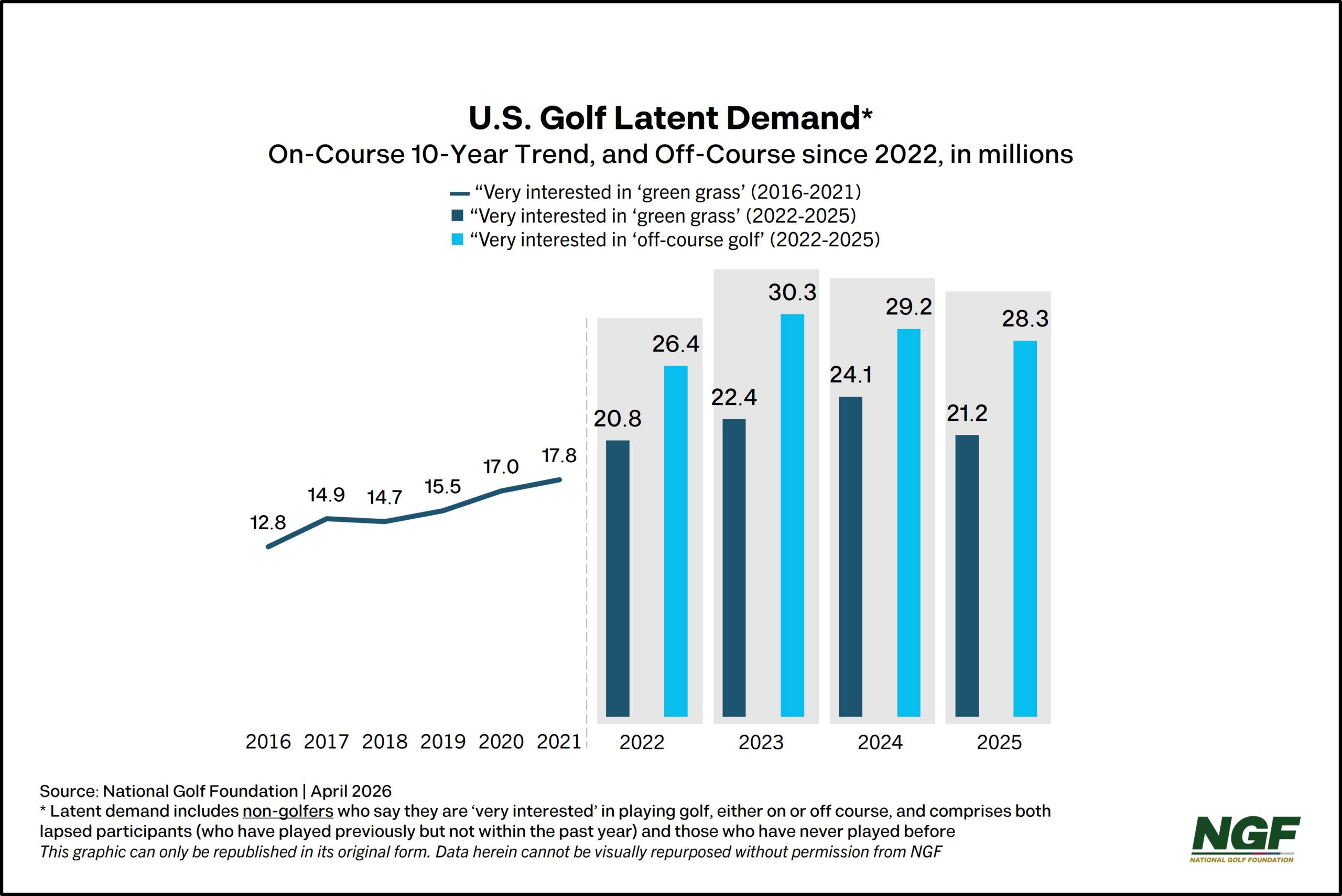
Why nobody's panicking (and why they should be).
Here's where I want to be fair, because it would be easy to be cynical and wrong. When demand suddenly outstrips supply, every rational operator does the same handful of things. You raise membership fees, because you can. You build a waitlist, because you have to. You premium-price the retail and the lessons, because the market clears anyway. You push range and entertainment volume, because that's where the throughput is.
None of that is villainy. It's basic economics, and most of the people doing it are good operators making sensible calls inside a boom. I don't think the industry is greedy. I think it's responding correctly to the wrong scoreboard.
Because every one of those levers is tuned to the same thing: extracting maximum value from year-one golfers. Not building year-ten ones. And when new bodies keep arriving to replace the ones who quit, the spreadsheet never forces the question. Rounds are up. Revenue is up. Utilisation is up. Why would you go looking for a problem?
The tell is in what we measure. We count rounds played, dollars spent, tee sheets filled. We are extraordinarily bad at counting the people who didn't come back — and even worse at asking why. A 75% beginner churn rate would be a five-alarm fire in any subscription business on earth. In golf, it's invisible, because the top of the funnel is gushing. A boom doesn't fix a retention problem. It finances one — right up until the inflow slows.
A personal aside: the crickets.
Here's the thing that got me thinking about all of this in the first place. For months now I've been trying to join a club closer to home. Nothing complicated — I just want to play more golf, practise somewhere that feels like mine, and be around people who love the game as much as I do. So I reached out. A few calls, a few emails, a few polite enquiries about membership.
The response rate has been, to put it generously, crickets.
And I genuinely get it. Why would they chase me? The waitlist is full. The tee sheet is jammed. The phone rings whether or not anyone calls me back. In a boom, they don't need me — and, if we're honest, they don't need much of anyone right now. That's not rudeness. It's just what abundance does to urgency.
But here's what nags at me. I'm about as easy a customer as this game will ever get: I already love it, I'm ready to commit, I'd sign up tomorrow. If I can't get a reply, what happens to the person who's only half-sure? The newcomer who isn't certain they belong in the first place, working up the nerve to ask — and meeting silence on the other end? The boom hasn't only raised prices. It has quietly raised the drawbridge. And the people most likely to bounce off a closed door are exactly the ones we claim we want: the 21 million standing outside, waiting to be let in.
The leak isn't price. It's belonging.
The instinct is to blame cost. Golf is expensive, fees went up, of course people bounce. And cost is real — I'm not going to pretend initiation fees running into the thousands, sometimes hundreds of thousands, and a two-year waitlist are welcoming. But the same research quietly tells you cost is the excuse, not the cause. Look at what's actually stopping people:
- Only 36% of non-golfers feel comfortable around other golfers.
- Roughly half aren't sure they'd even feel welcomed at a course.
"Half the people interested in this game already suspect it isn't for them — before a single green fee is paid."
They don't quit because the round was too expensive. They quit because they never, for one second, felt like a golfer. Cost just gives them a respectable reason to stop doing something they already felt awkward doing.
I made this exact point in a different argument a few weeks ago: some people sink a 30-footer with a putter they found at a garage sale, and others can't with a $500 one. The thing that determines whether someone stays isn't the equipment, and it isn't the access. It's identity and progress. Do I belong here, and am I getting better? Golf, as an industry, sells everything except those two things.
The hobbies that already solved this.
The frustrating part is that retention isn't a mystery. Other lifetime hobbies cracked it years ago.
Climbing gyms turned a fringe, intimidating activity into a community you belong to on day one — you're a member of the gym before you can climb anything hard. Ski resorts built season-pass ecosystems that sell identity and belonging, not just lift access. Parkrun turned running — free, no equipment, no facility — into a weekly community ritual with visible progress baked in. Even Peloton, for all its troubles, understood that the leaderboard and the instructor knowing your name retained better than the hardware ever could.
Every one of them built retention on the same three things: community, visible progress, and identity. None of them led with equipment and access — the two things golf leans on hardest. And here's the part that should sting: golf has richer retention data than any of them. Every shot is a number. Every round is a dataset. We capture more about a golfer's experience and progress than a climbing gym could dream of — and we use almost none of it to make anyone feel like they're improving, like they belong, or like anyone noticed they stopped showing up.
The long-tail playbook: year 2, year 7, year 15.
So what would it actually look like to build for the 10-, 20-, 30-year golfer instead of the one-year trial-and-bounce? It changes by stage.
- Year one — stop selling a membership, start onboarding a golfer. The single highest-leverage fix in the whole industry is aimed straight at that 50% who doubt they belong. Not a starter-set discount — a deliberate welcome. Someone who knows your name. A first month designed so you leave each visit feeling more like a golfer, not less. Most clubs spend their entire marketing budget on acquisition and approximately nothing on the first ninety days. That's exactly backwards.
- Years two to seven — make progress visible, and make it bigger than the scorecard. This is where most golfers silently plateau and drift. A handicap helps, to a point — but it's a narrow measure, and for a slowing improver it mostly reports that they've stopped improving. Progress has to mean more than scores posted. It's playing more often, not less. It's the parts of the game that quietly got sharper. And it's the world that grew around it — the fourball that became friends, the friends that became a circle, the business contacts you'd never have met on a driving range. The golfers who stay aren't just shooting lower; they're more woven into the game, and into each other's lives, than the day they started. That's the progress worth reflecting back to someone — and it's where the richness of golf data, on the course and off it, could finally earn its keep.
- Years ten and beyond — identity and community. The golfer who's stayed a decade isn't retained by a discount. They stay because the club is part of who they are, and because they're the one now bringing the next three members through the door. Retention, done right, compounds. One ten-year member is worth more than the marketing that would replace them — and they recruit for free.
You'll notice none of those three stages is primarily about equipment or access. The industry's two favourite levers barely appear. That's the point.
The question worth sitting with.
I'll be honest about my own bias: I think the data is sitting right there, unused, and that the tools to act on it have never been cheaper or better. So I'm probably more optimistic than most that this is fixable. But fixable and fixed are different words.
The boom has handed the industry a once-in-a-generation gift — and a once-in-a-generation excuse to ignore the leak. As long as 21 million people are knocking, you can lose three of every four and still post record numbers. Until, one season, the knocking gets quieter, and the math you've been avoiding shows up all at once.
So here's the question I'd put to anyone running a club, a brand, or a tour: what's your three-year golfer retention number — and does anyone in your organisation actually know it? If the answer is "rounds are up, so we're fine," that's not an answer. That's the boom talking.
Let's actually discuss this one — what's keeping people in the game beyond year one, in your experience? Acquisition we've clearly figured out. It's everything after the front door I'm less sure about.
Gareth Londt — Founder & CEO
Sources
National Golf Foundation — 20+ Million Golfers On-Deck. Latent-demand, on-course and off-course participation, beginner-retention and "feeling welcomed" figures: NGF. Comparisons to other membership and fitness categories are illustrative.