
The data brain of golf
Golf's Future Is Female. Here's How Not to Waste It.
8.1 million women now play golf — a record. Everyone's celebrating the number. Almost no one's asking the question that decides whether it lasts: how did they get here? Women didn't come back to golf. They came in through a different door.

Golf's future is female.
The headline writes itself, and it's a good one. 8.1 million female on-course golfers in 2025 — the most ever recorded. Women's participation is up 45% in six years, versus 12% for men. Women and girls made up 52% of all the net new golfers since 2020. Roughly 28% of on-course golfers are now women, the highest share on record, up from 20% in 2012.
It's a genuinely great story. But it's the answer, and I'm more interested in the question underneath it: why now, and through what door? Because that's the part that tells you whether this is a foundation or a bubble.
We've stood on this exact record before.
Here's the detail almost no one celebrating the 8.1 million is mentioning: women's golf hit a record once before — 7.1 million players in 2006. Then, from 2007 to 2012, it dropped 30% — a net loss of 2.1 million women. The same demographic being hailed as golf's saviour today quietly walked out the door fifteen years ago.
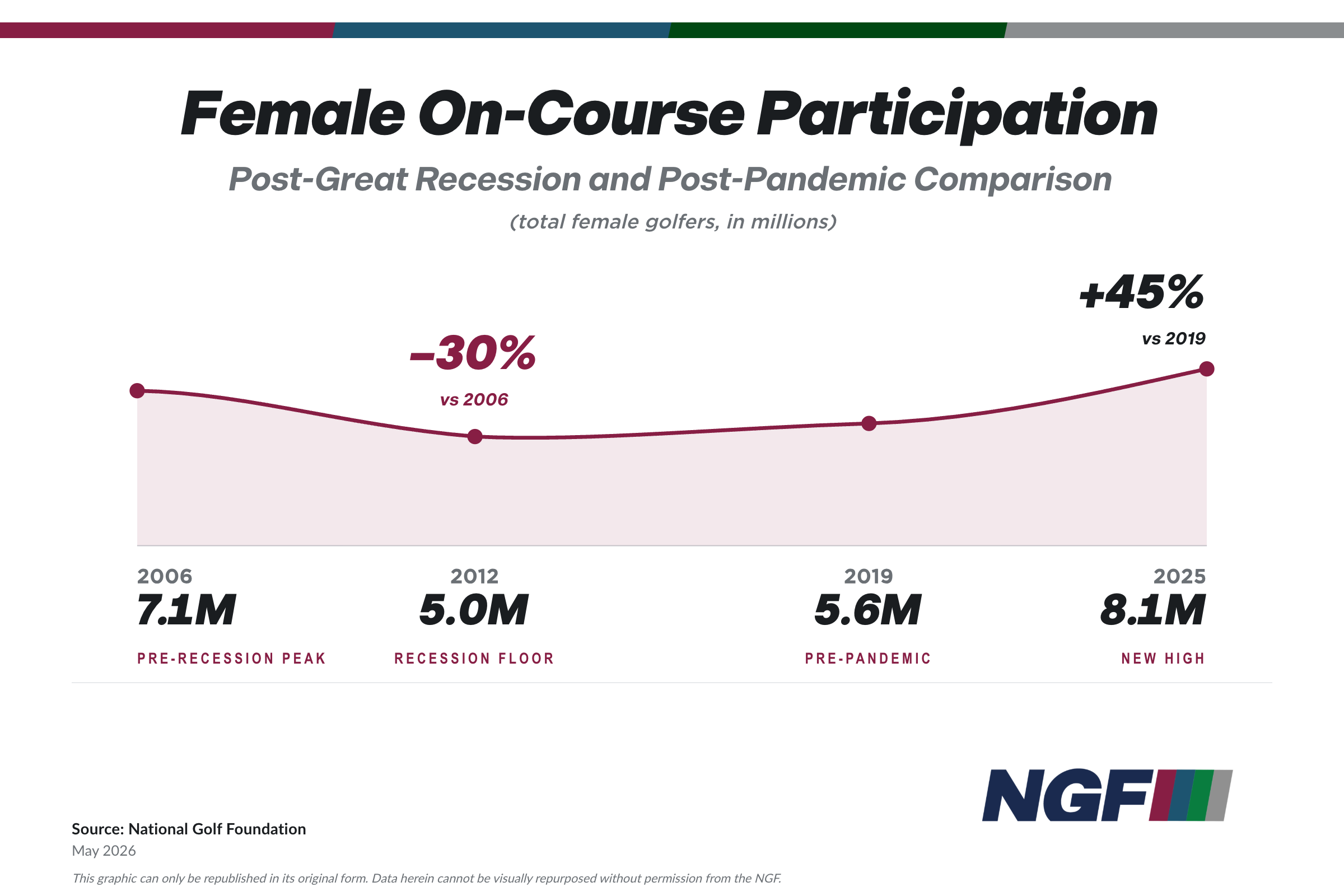
So "women love golf now" can't be the whole explanation, because women loved golf in 2006 too — right up until they didn't. If we want to know whether 2025 holds, we have to know what's structurally different this time. And there is something different. It's the door they came in through.
The entry point inverted.
For decades, the on-ramp to golf was the golf course. You were introduced by a parent or a partner, you bought clubs, you suffered through a few rounds, and either it stuck or it didn't. That funnel was built for, and largely by, men. It's also intimidating, slow, expensive and unforgiving — which is exactly why it leaked women for a century.
That's not how most women are entering today. They're coming in through a side door the industry didn't design and barely controls:
- Off-course first. Around 8.2 million women played golf off-course — Topgolf, simulators, social venues — in 2024. The range used to be where you went after you committed. Now it's where the commitment gets created, minus the intimidation.
- Community is the product, not the perk. The fastest-growing formats — social leagues, beginner clinics, mixed-ability simulator nights — sell belonging first and golf second. For a new player walking into a sport that historically signalled "you don't belong here," that ordering is everything.
- Identity and apparel. A wave of female-founded apparel brands made it possible to look like a golfer before you can play like one — and looking the part is a real driver of belonging.
- The junior pipeline turned. 35% of junior golfers are now girls, up from 15% in 2000. That's not a spike; it's a generational supply change that compounds for 30 years.
Someone who's hit balls at an entertainment venue is roughly five times more interested in playing an actual course than someone who hasn't. The driving range stopped being the place you go after you commit. It became the place the commitment is made.
Put those together and the picture is clear: this isn't the same demographic rediscovering the same game. The funnel itself changed shape. Women are arriving curious, social, low-commitment and off-course — and the green-grass industry is receiving them with an on-ramp built for the old funnel.
Which is exactly why 2006 should scare us.
In 2006, the record was real and the collapse was also real — because the growth was never converted into retention. Trial isn't loyalty. A Topgolf birthday party isn't a membership. What killed women's golf last time wasn't a lack of interest; it was a leaky conversion from "I tried it and liked it" to "this is part of my life," at a course environment that wasn't designed to catch her.
That leak is still there. The off-course door is wide open; the on-course on-ramp is still the same intimidating staircase it always was. The growth you're reading about is happening upstream of most clubs — and it will reverse again if the handoff from curiosity to commitment keeps leaking.
The industry is measuring the wrong number.
Here's the operator's version of all this. 8.1 million is a lagging indicator — it tells you what already happened. The clubs that win the next decade will be the ones watching the leading indicators of the new funnel, the ones the tee sheet doesn't show you:
- Where is she actually entering — off-course, a clinic, a friend's guest pass, a junior program?
- Does she come back solo, or only when it's social? (The answer changes everything about how you program.)
- What's the real drop-off point between her first visit and her fifth — and what happened right before she stopped?
- Is your junior-girl pipeline a feeder, or a leak?
Almost no club can answer those, because almost no club instruments the female on-ramp. They count rounds and revenue — the lagging numbers — then guess at the why. That's the same mistake we see everywhere AI and data get bolted onto a business as an afterthought: you can't fix a funnel you've never actually measured.
What to do with this.
If you run a club, an association or a facility, the takeaway isn't "market to women." It's narrower and more useful than that: find your side door, then build the on-ramp it deserves.
- Instrument the entry point. Know — with data, not anecdote — how women are actually arriving and where they fall out. That's a measurement problem before it's a marketing one.
- Design for the social on-ramp, not the solo one. Trial is overwhelmingly social. Program for the group first, then build the bridge to the individual round.
- Treat the junior-girl pipeline as a 30-year asset, and measure it like one.
- Convert, don't just count. The record number is upstream of you. Your job is the handoff from curiosity to commitment — and that handoff is a retention system, not a flyer.
"The 8.1 million is wonderful. It's also fragile, and we have the receipts from 2006 to prove it."
The clubs that treat this as a permanent tailwind will get the same lesson twice. The ones that treat it as a funnel to be measured and a door to be widened will own the most important growth demographic in golf for a generation.
Women came in through a different door. The only question that matters now is whether the industry bothers to learn where it is.
Gareth Londt — Founder & CEO
Sources
National Golf Foundation — The Record Rise of Female Golf, Golf Participation: Growing & Diversifying, Can Short-Form Golf Transform Female Retention? Participation figures: NGF. Off-course, apparel and market-size figures are directional, drawn from industry and market research.